
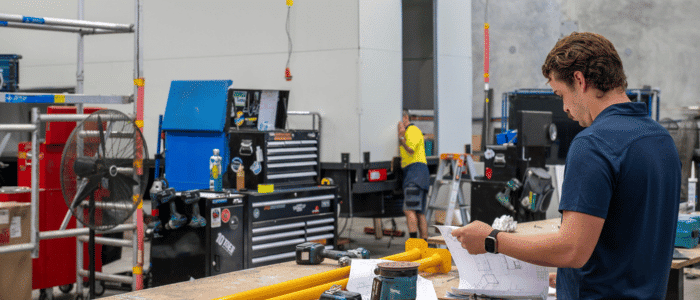
How a fleet expansion brief becomes a fully compliant, road-ready mobile unit.
Building a custom food truck is typically a five-stage process: design consultation, CAD and engineering, structural fabrication, fit-out, and compliance testing.For an established food or beverage brand adding a mobile unit, the build is best understood as a fleet decision rather than a start-up project. The truck should match existing brand standards, meet the same food-safety and roadworthy requirements as every other location, and be repeatable for when further units follow.
The five stages of a custom food truck build
1. Consultation and design brief
The process starts with the operational brief: menu and service style, volume targets, equipment list, and brand standards for livery, signage and interior finish. For a franchise or multi-site operator, this stage is where scalability gets built in — the goal is a spec that can be built once and repeated across further units.
2. CAD and engineering
The brief is then translated into a 3D model covering equipment layout, plumbing and electrical runs, weight distribution, and chassis compatibility. Engineering sign-off happens before fabrication starts, so any conflicts, for example a servery window that clashes with a structural element, or equipment that overloads one side of the vehicle, are resolved on screen, not on the shop floor. For a fleet, this stage also produces the reference drawing that every subsequent unit is built to, so unit two and unit ten match unit one.
3. Chassis and structural fabrication
Structural welding, insulation, wall and roof panelling, and the plumbing and electrical backbone go in before the fit-out. This stage determines how the truck holds up over years of daily service and repeated loading, not just how it presents on delivery day.
4. Fit-out and customisation
Kitchen equipment, refrigeration, cabinetry, servery windows, and POS and signage integration are built to the exact menu and workflow specified in the brief. This is where customisation stops being cosmetic and the equipment and layout are matched to how the operator actually works, station by station. For multi-unit brands, this stage is run against the reference spec from stage two, so every truck in the fleet performs and presents identically.
5. Compliance, testing and handover
Food-safety certification, gas and electrical compliance, and roadworthy and registration sign-off are completed, followed by a functional test of every system before handover. For an operator managing risk across multiple sites, this stage is important to ensure the mobile unit remains a liability, not an asset.
What this looks like in practice
Take a regional coffee chain with forty stores, deciding to trial mobile service ahead of a summer events season. The brief covers three units: matching the in-store espresso setup, a target of coffees per hour, and enough flexibility to run offshore power at a corporate campus or a generator at an outdoor market. The brief drives the CAD stage and the model is built around the actual machine footprint and a two-person workflow, not a generic servery layout. The resulting reference spec is what all three units are fabricated and fitted out against. By the time the first truck clears compliance testing, the design decisions for units two and three are already made, meaning the the trial can scale into a permanent fleet addition without going back to the drawing board.
What can go wrong in a lower-quality build
Most of the problems operators run into with a mobile unit trace back to a stage that was rushed or skipped, not bad luck. Engineering that’s an afterthought shows up as weight imbalance across the axles, uneven tyre wear, or a registration inspection that doesn’t pass. Insulation and panelling done to a lower standard trap moisture in the wall cavities, and rust follows within a couple of seasons of daily service. Electrical and gas work that hasn’t been properly certified is a safety risk on its own, and it has a habit of surfacing at the worst possible time – the day before a scheduled event, not during a routine check. And a fit-out built without real reference to the operator’s menu and workflow leaves staff working around the truck instead of the truck working for them, which shows up as slower service and lower efficiency than the same team gets in-store. None of this is new, it’s what the consultation, CAD and compliance stages exist to prevent.
How long does a custom food truck build take?
A fully custom build typically takes 8 to 12 weeks from signed-off design to handover, depending on equipment lead times and fit-out complexity. Because the CAD and engineering stage front-loads the major decisions, the timeline remains even when a brief covers additional units later because the second and third truck don’t require a new design cycle.
What makes a build “fully customised”?
Two things, held equally: engineering precision and complete customisation. A layout that looks right on paper still has to pass a certifier and hold up to daily commercial use — that only happens when the CAD work and the fit-out are built by the same team, against the same reference spec, rather than handled as separate projects. For a brand expanding an existing operation into mobile service, that combination is what makes a design scalable across one unit or an entire fleet.
What drives the cost of a custom food truck?
There’s no single figure that applies across builds, cost is a function of a handful of specific decisions rather than a flat rate. Chassis and vehicle size matter first and depend on weight: a trailer, a light truck and a larger commercial chassis all carry different base costs, and starting from a vehicle you already own changes the equation again.Equipment specification is the next lever. Commercial-grade cooking and refrigeration equipment across several stations costs more than a simpler single-station setup, and that choice should be driven by the menu, not the budget alone.The level of customisation plays a part too: fully bespoke cabinetry and integrated branding takes more design and fabrication time than a simpler standard layout.The reliable way to get an accurate number is a consultation against your actual brief but knowing the factors that influence the cost makes that conversation useful. If you’re expanding an existing food or beverage brand into mobile service, whether it’s one unit or a planned fleet, talk to us about a build spec that scales with you.
A fully custom build typically takes 8 to 12 weeks from signed-off design to handover, depending on equipment lead times and the complexity of the fit-out.
Can the same design be used to build multiple food trucks for a franchise or fleet?
Yes. The CAD and engineering stage produces a reference spec that later units are built against, so additional trucks match the original in layout, equipment and finish without repeating the full design cycle.
What compliance is required before a custom food truck can operate?
Food-safety certification, gas and electrical compliance, and roadworthy and registration sign-off, along with a functional test of every system, are completed before handover.
Does customisation slow down the build?
No. Customisation is resolved during the CAD and engineering stage, before fabrication starts, so the fit-out reflects the operator’s exact menu and workflow without adding rework later in the build.
A fully custom build typically takes 8 to 12 weeks from signed-off design to handover, depending on equipment lead times and the complexity of the fit-out.
Yes. The CAD and engineering stage produces a reference spec that later units are built against, so additional trucks match the original in layout, equipment and finish without repeating the full design cycle.
Food-safety certification, gas and electrical compliance, and roadworthy and registration sign-off, along with a functional test of every system, are completed before handover.
No. Customisation is resolved during the CAD and engineering stage, before fabrication starts, so the fit-out reflects the operator’s exact menu and workflow without adding rework later in the build.